
Insights · Topic
AI systems
Models, evaluation, grounding, agents, serving paths, and the cost per decision. 25 guides, plus related customer work and papers.
About this topic
These guides cover the engineering that sits around a model in production: how to frame the decision it supports, how to build an evaluation set that reflects real traffic, how retrieval and grounding keep answers tied to approved sources, and how agents are authorized before they act.
They also cover the operating side. Serving paths on Google Cloud, guardrails that hold under load, observability with tools such as Langfuse, and the cost per decision once a system is live all appear here, written from BluePi delivery work rather than from vendor material.
Technical guides
Every guide in this topic, including the articles featured on the insights index.
Nested Learning in practice: deep optimizers and multi-clock transformers
Understand Nested Learning, deep-optimizer geometry, multi-clock systems, and runnable reference implementations for continual learning.
Keeping AI actions under application control
Control identity, tenant access, spend, replay, approvals, and business commands outside the model.
Building evidence-grounded AI for business workflows
Assemble explicit evidence, check source versions, validate quotations, and return structured output for review.
How do you take an LLM application from pilot to production?
Define production release gates for LLM quality, reliability, cost, security, monitoring, ownership, and tested rollback.
How do you design human-in-the-loop workflows that scale?
Design human review with clear authority, tested routing, reviewer rubrics, queue capacity, and a controlled feedback loop.
When should you fine-tune instead of prompting or RAG?
Compare prompting, retrieval, and fine-tuning using held-out tasks. Assess behavior, changing knowledge, serving cost, and model maintenance.
How do you reduce hallucinations in production RAG systems?
Reduce unsupported RAG answers with retrieval tests, claim-support checks, source version controls, and an evaluated abstention path.
How do you monitor LLM applications in production?
Monitor production LLM applications across serving, behavior, and inputs. Set useful alerts, evaluate sampled outputs, and protect sensitive trace data.
How do you release and roll back a prompt or model change?
Version the prompt, model, retrieval, and tool settings as one release. Test the combination, watch live outcomes, and practice a specific rollback path.
What does a production LLM request actually cost?
Calculate production LLM cost per completed task across model calls, retrieval, retries, tracing, and human handoffs, then compare cost with quality.
How do you evaluate LLM output quality before and after launch?
Evaluate LLM answers before launch with a clear rubric and failure cases, then sample live traffic to catch new risks and keep releases accountable.
Building feedback into a decision system
A decision system earns trust by capturing outcomes: what was proposed, what people did, and what followed. How to capture, attribute, evaluate, and update.
Where a production AI system gets its operational data
The four operational inputs behind a production AI decision: request context, event streams, governed reference data, and captured outcomes.
How do you choose between OpenAI, Anthropic, and Google models?
OpenAI, Anthropic, or Google: compare models on your evaluation set, price the winner, and put durable advantage in workflow, data, and operations.
What does LLM observability look like with Langfuse?
Langfuse traces, offline and online evaluations, cost per decision, and prompt versioning for production LLM systems.
What do LLM guardrails look like in production?
Production LLM guardrails layer input checks, retrieval and tool boundaries, output contracts, rate limits, traces, and red-team tests.
How do you choose an embedding model?
Choose an embedding model from your languages, query style, and corpus. Run a blind bake-off with recall at k and chunking variants.
When should you fine-tune a small language model?
Fine-tune a small language model when the task is narrow, stable, and high-volume. Data requirements, hidden costs, and a safe routing pattern.
How do you optimize LLM inference cost per decision?
Reduce LLM inference cost per decision through model routing, context control, caching, batching, and serving tiers matched to traffic.
How do you govern enterprise AI agents that take actions?
Enterprise AI agent governance separates advisory answers from authorized actions, with tool permissions, audit records, refusal tests, and rollback.
How do you make RAG answers show their sources?
Grounded RAG answers cite the source behind each claim. Source control, retrieval, refusal paths, and citation correctness in production.
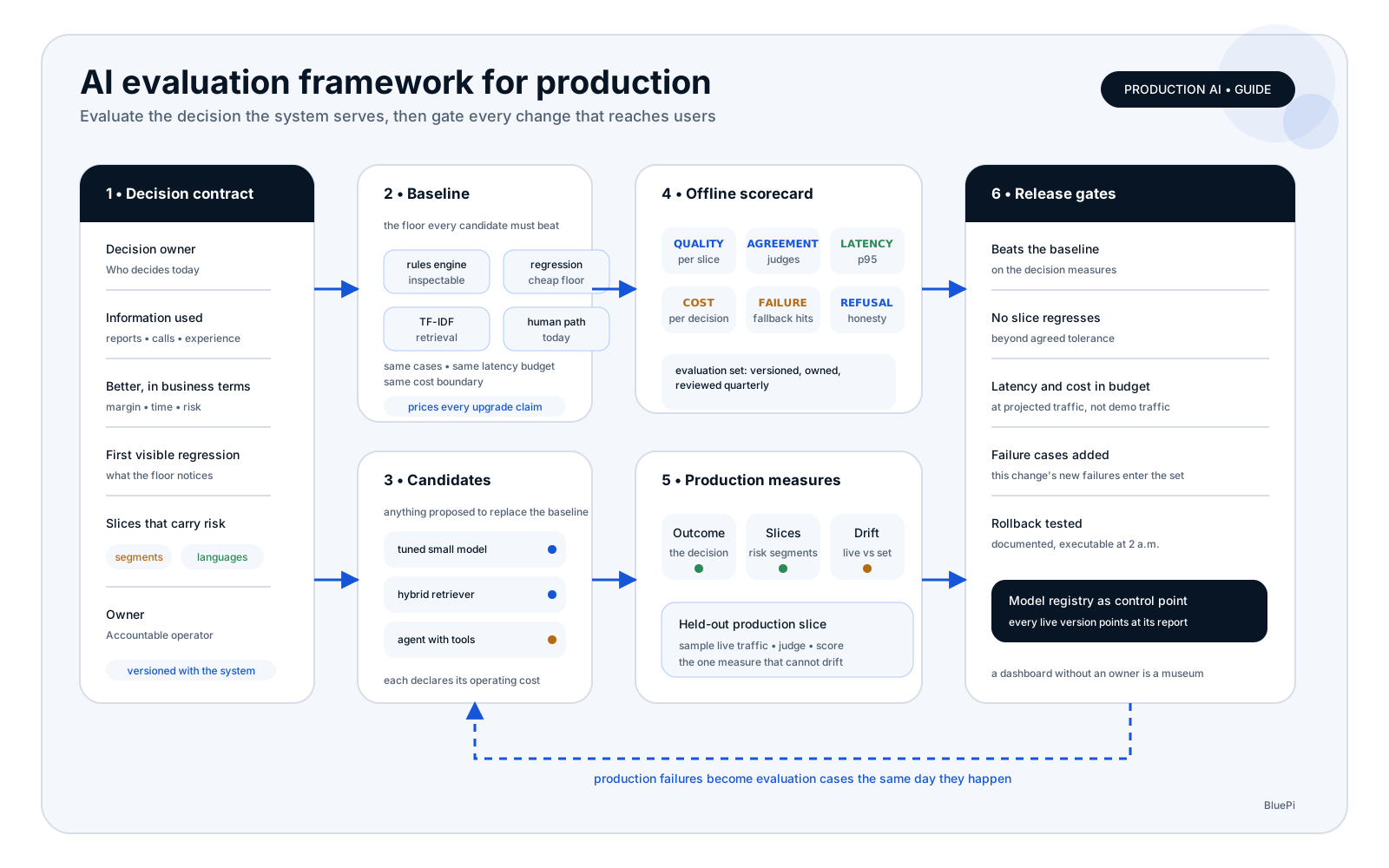
What is an AI evaluation framework for production systems?
A practical AI evaluation framework: decision framing, baselines, slice measures, drift signals, and release gates that keep deployed systems owned and improving.
Production inference on Google Cloud: choose the serving path from the workload
Choose a Google Cloud inference path using model size, latency, traffic, control, reliability, evaluation, and cost requirements.
Hybrid recommendation systems: combine signals and measure the decision
Design a hybrid recommendation system with clear candidates, ranking, fallbacks, evaluation measures, and operating controls.
TF-IDF for document retrieval: build the baseline before adding complexity
Learn how TF-IDF weights terms, how cosine similarity ranks documents, and how to evaluate a lexical retrieval baseline.
Customer work and research
Customer work and technical guides on this topic.
A quick-commerce service assistant designed around policy and permitted actions
BluePi designed a customer-service assistant that can classify a request, use approved policy information, request a permitted order action, and transfer the case to a person. The source is a low-level design, not proof of production deployment or measured results.
A quick-commerce catalogue team made product-image processing repeatable
BluePi implemented a documented image-processing job that reads product image links, creates background-removed versions, selects an output, applies the required aspect ratio, stores each result, and writes an output file. Wider catalogue enrichment remains proposed scope.
An enterprise assistant separated advisory answers from protected transactions
BluePi built a usable demonstration that routes advisory questions to approved knowledge and protected business requests to authorised enterprise tools. The pilot shows the interaction and control pattern. Draft metrics and testimonials are excluded.
An apparel exporter prepared mixed purchase orders for ERP entry
BluePi documented a workflow that extracts fields and tables from purchase orders in several formats and prepares a common file for ERP entry. The source does not confirm delivery stage or validate its draft outcome figures.
A multilingual chatbot addressed repetitive support questions
Seventy percent of the organization’s customer queries repeated questions support executives had already answered. BluePi designed an AI-enabled chatbot using structured question-and-answer content and natural-language understanding across digital and voice channels.
A dealer recommendation system increased click-through rate by 15%
A distributor wanted to improve product discovery across a 16,000-dealer network. BluePi prepared catalogue, dealer, purchase, and SKU data on AWS and built recommendation paths for related products, similar-dealer behavior, and seasonal stocking.
DHFL Pramerica used an AWS data lake to turn policy data into customer risk profiles
DHFL Pramerica needed a consolidated customer view and a repeatable way to assess risk before recommending insurance products. BluePi built a machine-learning path from life-policy data through AWS Glue, Amazon S3, Amazon EMR, and Amazon Redshift. The system produced high-, medium-, and low-risk customer segments from demographic, education, health, and policy attributes.
Other topics
Continue through the library by problem area.