
Insights · Topic
Data platforms and Snowflake
Pipelines, modeling choices, security, and clean-room trust boundaries. 4 guides, plus related customer work and papers.
About this topic
Guides in this topic explain how BluePi designs and operates data platforms: event-driven ingestion on Google Cloud, warehouse modeling choices such as star and snowflake schemas, and the security and clean-room controls that let Snowflake serve several parties safely.
Each article states what the platform must guarantee to its consumers, how that guarantee is tested, and who operates the result after release, so the reader can judge the design against their own workloads.
Technical guides
Every guide in this topic, including the articles featured on the insights index.
Why does more data technology not fix analytics?
More data tools can make analytics slower. Pipeline seams, duplicate definitions, and ownership gaps lengthen the path from question to answer.
Design event-driven ingestion on Google Cloud
A nightly BigQuery load scheduled in Airflow moves data in batches, so reports lag the source by up to a day. Event-driven ingestion replaces the schedule with triggers: change streams, object-finalize notifications, and published business events start the affected workload the moment state changes. Data arrives sooner, each run traces to the event that caused it, and consumers read current state instead of yesterday's.
Build a Snowflake security operating model
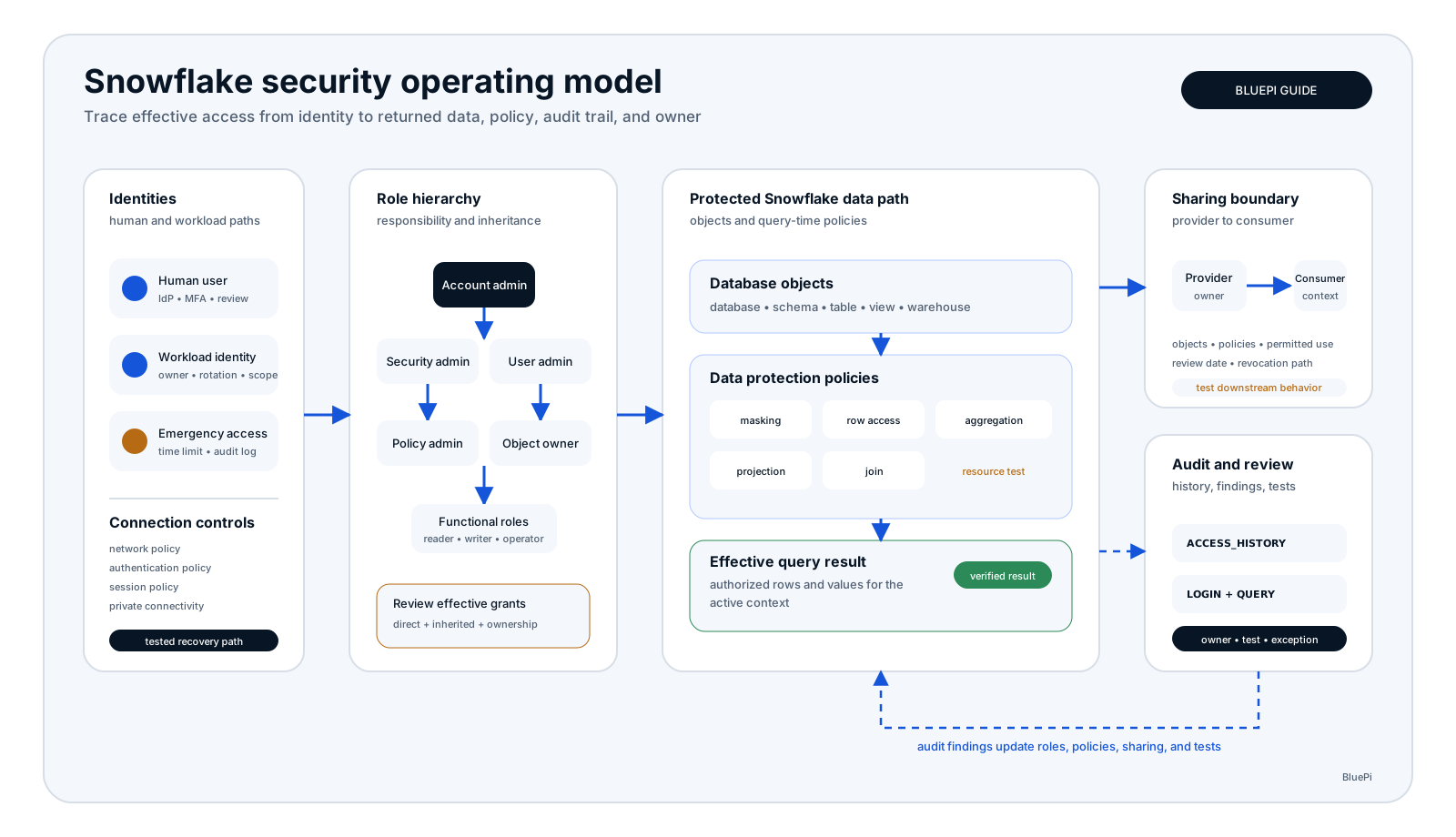
Snowflake security rests on five control areas: key-based authentication and SSO for identity, roles and grants designed around protected resources rather than job titles, network policies and PrivateLink for reachability, masking, row access, and tags for data protection, and audit logging with a scheduled review. Test each control along the effective access path from identity to the rows a query returns.
Snowflake data clean rooms: controls before collaboration
Plan a Snowflake data clean room around approved questions, join controls, output limits, audit records, and operating ownership.
Customer work and research
Customer work and technical guides on this topic.
A logistics platform moved operational changes into BigQuery in near real time
BluePi built a Google Cloud MVP that captured changes from MySQL, PostgreSQL, and MongoDB with Debezium Server. Optimized BigQuery procedures made current operational data available for reporting at a lower cost and shorter runtime.
Housing unified departmental KPIs and governed data access on Snowflake
Housing’s data and reports were distributed across departmental systems, leaving teams with conflicting KPI definitions and limited access. BluePi consolidated the data in Snowflake, standardized KPIs, and introduced role-based access and cataloguing.
Delhivery built a petabyte-scale AWS logistics data platform in six months
Delhivery needed current operating views across a rapidly growing parcel network while keeping historical package and scan data available for analysis. BluePi built an AWS data warehouse and near-real-time reporting path using Amazon S3, Kinesis, Storm, Redis, and Redshift.
DTDC centralized operational MIS and stakeholder reporting on Google Cloud
DTDC relied on manually assembled reports across sales, marketing, and operations systems. BluePi built a central Google Cloud reporting path with Dataflow pipelines, BigQuery, and Google Data Studio dashboards for MIS, bottleneck analysis, and senior-management KPIs.
A beverage bottler unified SAP and commercial reporting and saved 30 analyst hours each week
A beverage bottler lacked a consistent view of primary sales, secondary sales, inventory, finance, assets, and distribution. BluePi integrated SAP and commercial data on a governed cloud platform and automated reporting.
A QSR franchisee unified POS, SAP, and HR data for Snowflake reconciliation
A QSR franchisee worked across disconnected point-of-sale, SAP sales and inventory, HR, and related systems. Conflicting measures and manual reconciliation delayed financial and operating reports. BluePi integrated the sources in Snowflake, added continuous data-quality checks, and built transaction-matching workflows for investigation and correction.
Other topics
Continue through the library by problem area.