
Services
BluePi services connect to operating outcomes.
Each service family connects a business priority to a live data or AI system with defined ownership.
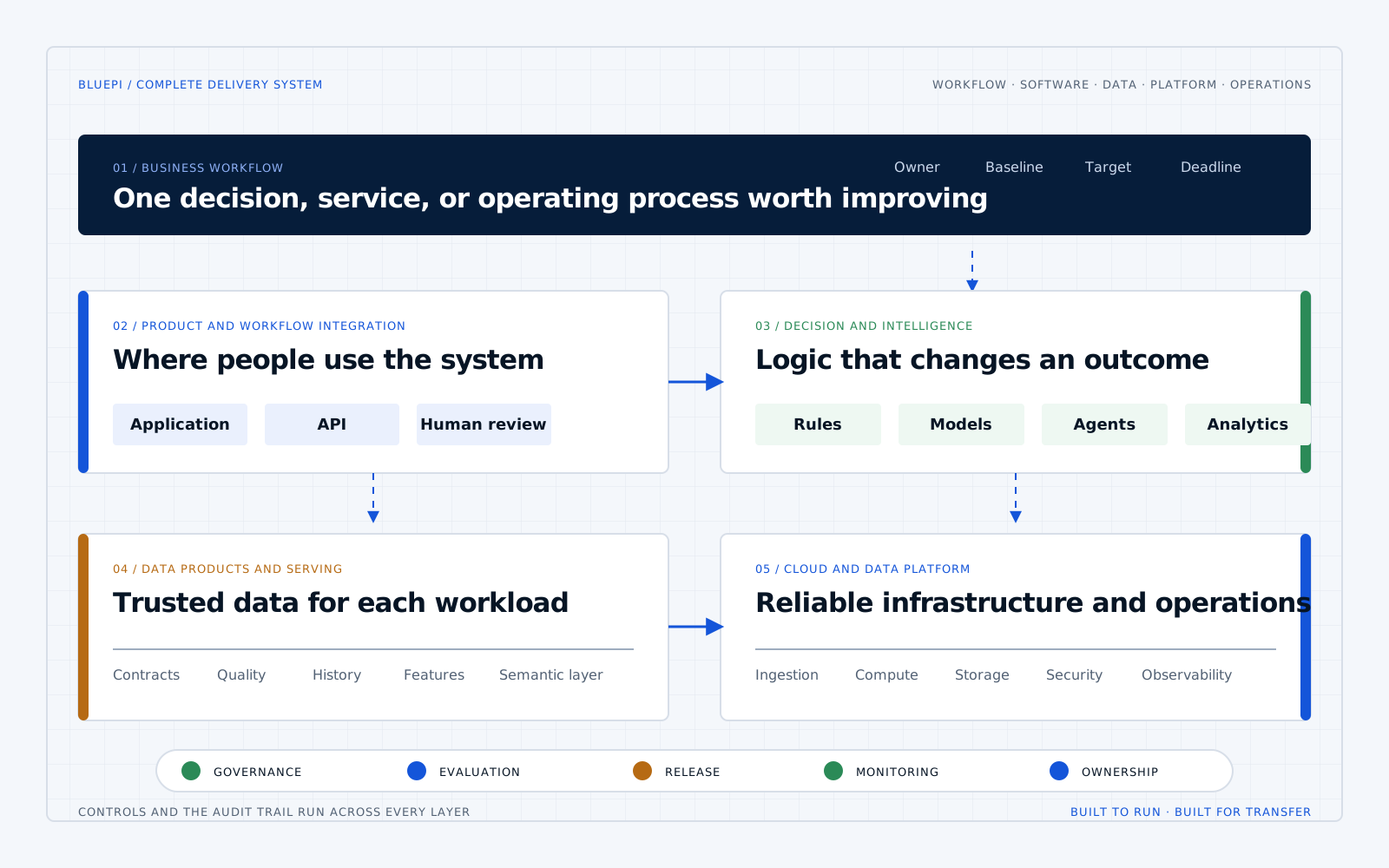
A delivery practice built in layers
BluePi began with cloud engineering in 2012 and developed a substantial AWS delivery record. The data practice followed, bringing data engineering, analytics, forecasting, governance, and platform modernization into the same engineering culture.
Today, the service portfolio supports complete systems in operation. The team can move from a business decision through the data foundation, software, model, controls, release, and operating transfer without dividing responsibility across disconnected workstreams.
The service families below are the long-standing view of that work. Data platforms, strategy, analytics, governance, and machine learning each have their own page describing scope, delivery approach, and the controls required to keep the result running. The solutions pages describe the same capabilities from the other direction: a recurring business problem such as demand forecasting, document processing, or a platform migration, and the complete system that addresses it.
Most engagements draw on more than one family. A forecasting use case needs a governed data foundation before a model is useful, and a platform migration is only finished when the reports and analytics on top of it are trusted again. BluePi scopes the first use case so that one team carries it from source data to a measured result, and the capability pages explain what each part of that work involves.
Choose the capability your operating problem needs
Each service page explains the system boundary, the delivery work, the controls required in live operation, and the measurements BluePi uses to track progress.
Data platforms
Build governed data foundations, pipelines, serving layers, and operating controls.
Data strategy
Turn business priorities and data constraints into an executable program.
Business intelligence
Build governed measures, semantic models, reports, and operational analytics.
Data governance
Apply ownership, access, quality, lineage, privacy, and audit records in deployed systems.
Data science and machine learning
Build evaluated models and complete AI systems for live workflows.