
Implementation overview · Apparel manufacturing and export
An apparel exporter prepared mixed purchase orders for ERP entry
BluePi documented a workflow that extracts fields and tables from purchase orders in several formats and prepares a common file for ERP entry. The source does not confirm delivery stage or validate its draft outcome figures.
01
Business context and previous workflow
The exporter receives purchase orders as PDF files, spreadsheets, and email content. Layouts differ by buyer. Staff identify required fields, read table rows, convert the data to a common structure, and enter it into the enterprise resource planning system.
This work is repetitive, but it also contains risk. A missing row, incorrect quantity, or wrong key-value match can move into production planning and fulfilment. The source describes an automated extraction path for this workflow.
02
Documented implementation
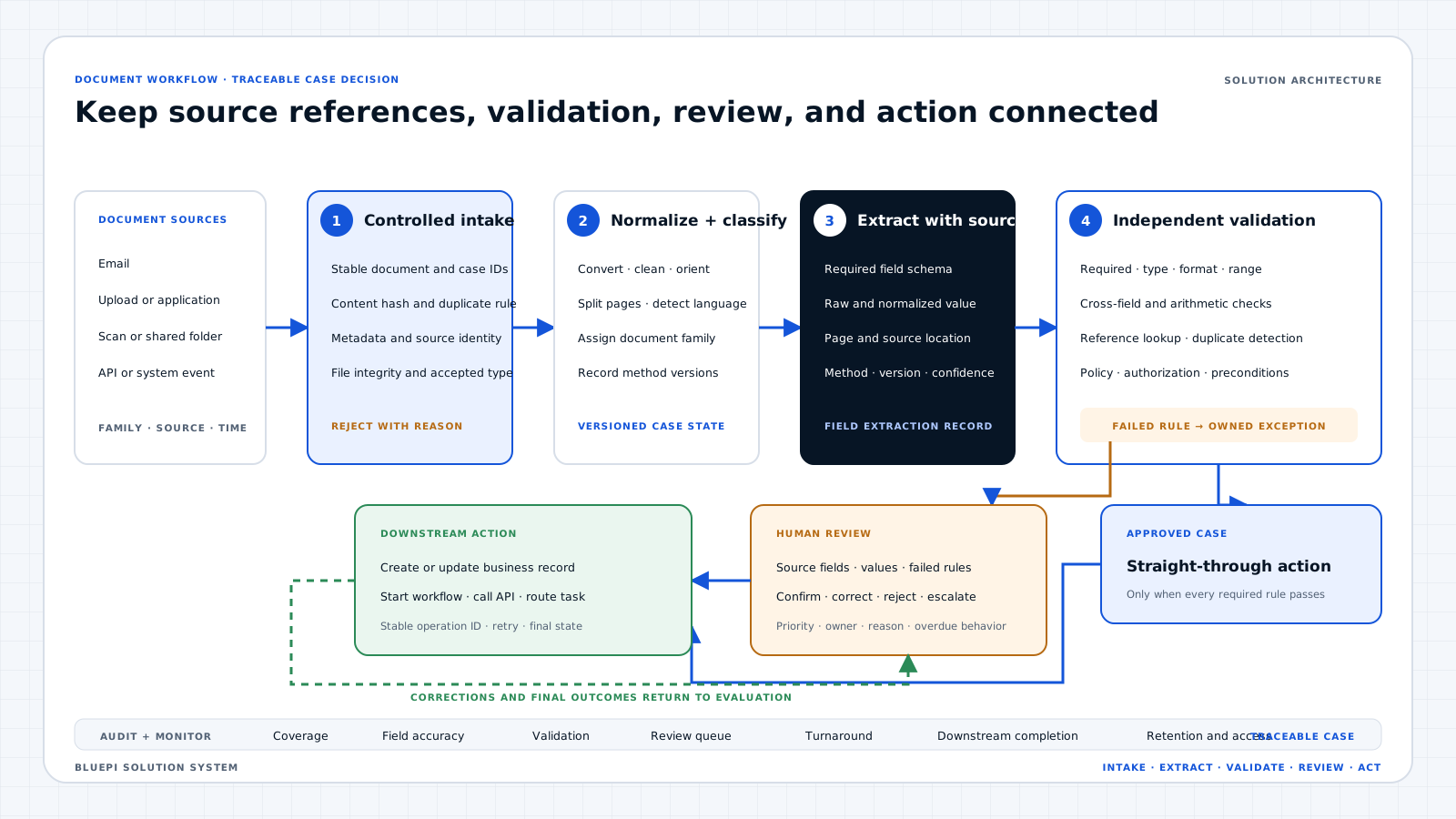
A selected template defines the fields required from a purchase order. A Python API processes the document. Computer vision detects table structures. OCR produces an intermediate representation for table cells and text. The workflow sorts text by page coordinates and matches requested keys to nearby values. It then prepares a common spreadsheet for the ERP handoff.
The design separates table extraction from text-field extraction because the two layouts behave differently. Intermediate results make it possible to review what the OCR and matching steps produced before the final file moves downstream.
- Template selection for required fields
- Table detection with computer vision
- OCR for tabular and free-text content
- Coordinate-based key-value matching
- Common spreadsheet and ERP handoff
03
Evidence and human review
A safe workflow keeps the source document and the extracted value together. A reviewer can compare low-confidence fields, unfamiliar layouts, missing pages, totals, and line items with the original purchase order. The system should block the ERP handoff when required fields are missing or control totals fail.
The source does not define approved confidence thresholds, review roles, exception states, or ERP acceptance controls. These items need confirmation before the page can describe a production control model.
04
Outcome claims remain unverified
The draft contains figures for purchase-order volume, team size, time, cost, and accuracy. A comment asks that these figures be vetted. Another comment asks whether the work is future or completed. This story therefore makes no quantitative outcome claim.
The supported value is the workflow design: convert mixed purchase-order layouts into a common, reviewable output for ERP entry. A current owner must confirm delivery stage and provide measured results before BluePi adds a stronger label or outcome.