
AI Practice
Three ways BluePi can help with AI
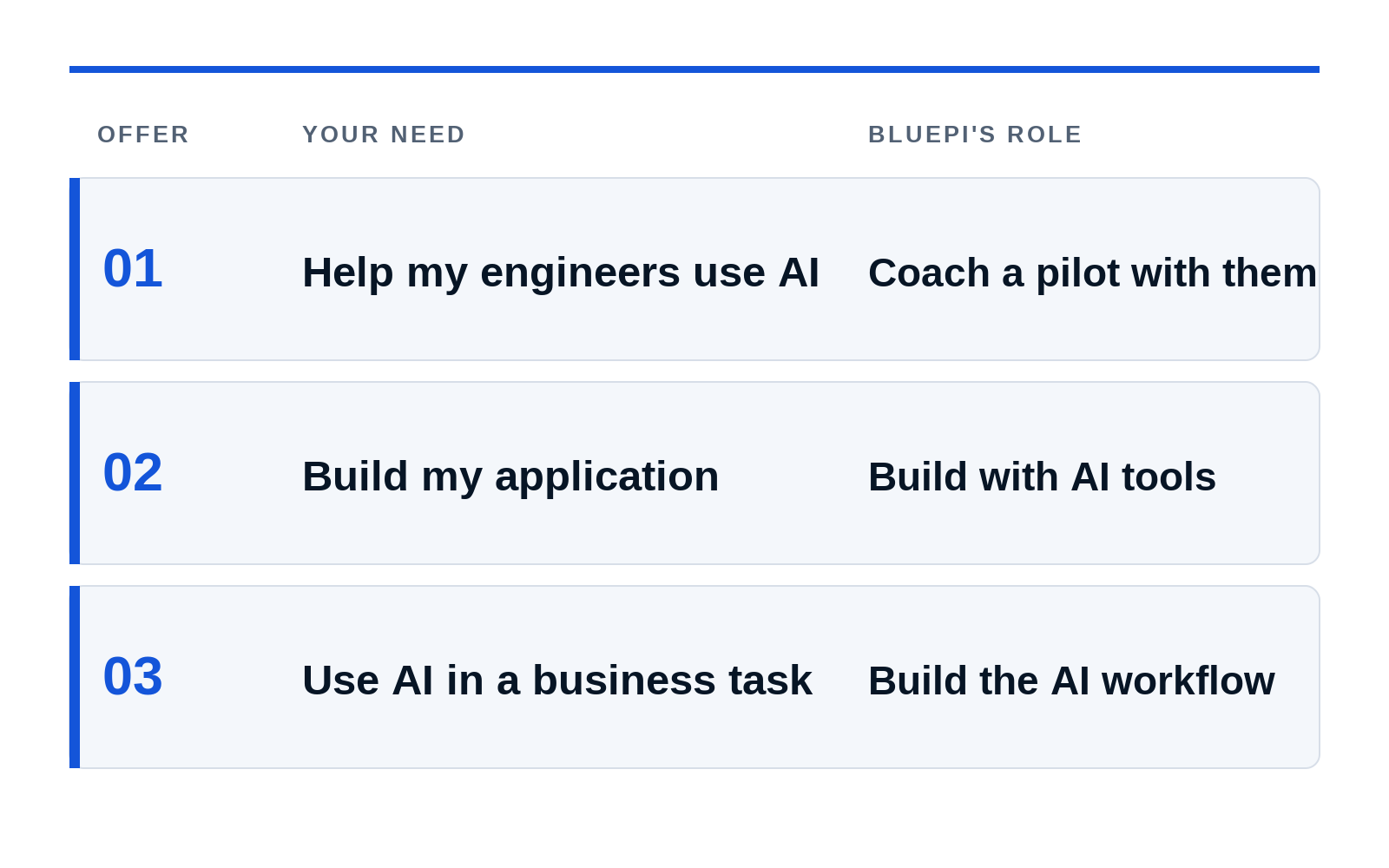
We help engineering teams use AI in their own work. We build applications, using AI tools where they help our engineers. And we build AI into business processes. These are different kinds of work, so start with the one you need.
01
Your engineers build, with AI support
Choose this when the team already owns the software and wants to improve how it plans, builds, checks, and releases changes. BluePi first reviews the team’s current path and chooses a suitable repository and type of task. If the work is ready, we set rules for tool access and review and run a measured pilot with the team.
Your engineers keep the decisions about design, merge, and release. The pilot ends with a working method for the selected task, test and review records, team training, and a decision about wider use.
02
BluePi engineers build your application
Choose this when you need a defined application or backlog delivered. BluePi engineers own the build and may use approved AI tools to help them inspect code, prepare changes, and write tests. They review the result, prepare the release, and hand it over with your team.
You receive working software, source code, tests, deployment records, and operating guidance. The application does not have to include AI. AI helps our delivery team where useful.
03
Your people use AI inside a workflow
Choose this when the work involves reading evidence, drafting an answer, checking a record, or proposing an action. BluePi defines what the AI may do, which information it may use, and where a person must review the result. The application checks identity, business rules, and permitted actions.
A first pilot uses representative cases and clear acceptance checks. Depending on the work, the result can be a reviewed draft, a recommendation, or a controlled action in another system.
What does BluePi build under production AI?
AI systems for business operations: the trusted data path into the system, model selection, integration with the live workflow, evaluation before release, monitoring after release, and human review where the decision matters.
How does BluePi keep an AI system reliable in daily use?
The system runs on governed data with quality checks, defined evaluation measures, production monitoring, and human review steps built into the workflow. Problems surface as signals the operating team can act on.
Where does a production AI engagement start?
With one use case the business already measures. The standard entry point is the first production deployment: a bounded system, a measurable baseline, and a clear owner on the customer side.
Bring one piece of work to discuss.
Bring an engineering task, an application backlog, or a business process. We will help choose the right offer and first scope.
Discuss your AI initiative