
Good fit
One use case has someone accountable for the outcome, a baseline the business already measures, and users who can judge whether the result improves.
Assess to transfer
BluePi assesses the current system, identifies the constraint, and moves workloads in controlled waves to a target the client team can operate.
Built on a substantial cloud engineering record
BluePi’s early Amazon Web Services (AWS) work covered major migrations, application systems, reliability, Redshift, serverless architecture, DevOps, and cost control. That experience remains the foundation for current platform modernization.
Modernization begins with workload behavior and business constraints. BluePi assesses architecture, dependencies, performance, resilience, security, deployment, cost, support, and the skills needed to run the target state.
When this is the right starting point
Good fit
One use case has someone accountable for the outcome, a baseline the business already measures, and users who can judge whether the result improves.
Poor fit
The request is capacity-only staffing, an unowned demonstration, or a broad transformation without a first decision and finish condition.
What you receive
01
The program starts with a defined operating problem such as slow releases, unreliable data, security exposure, infrastructure effort, or limited scale.
02
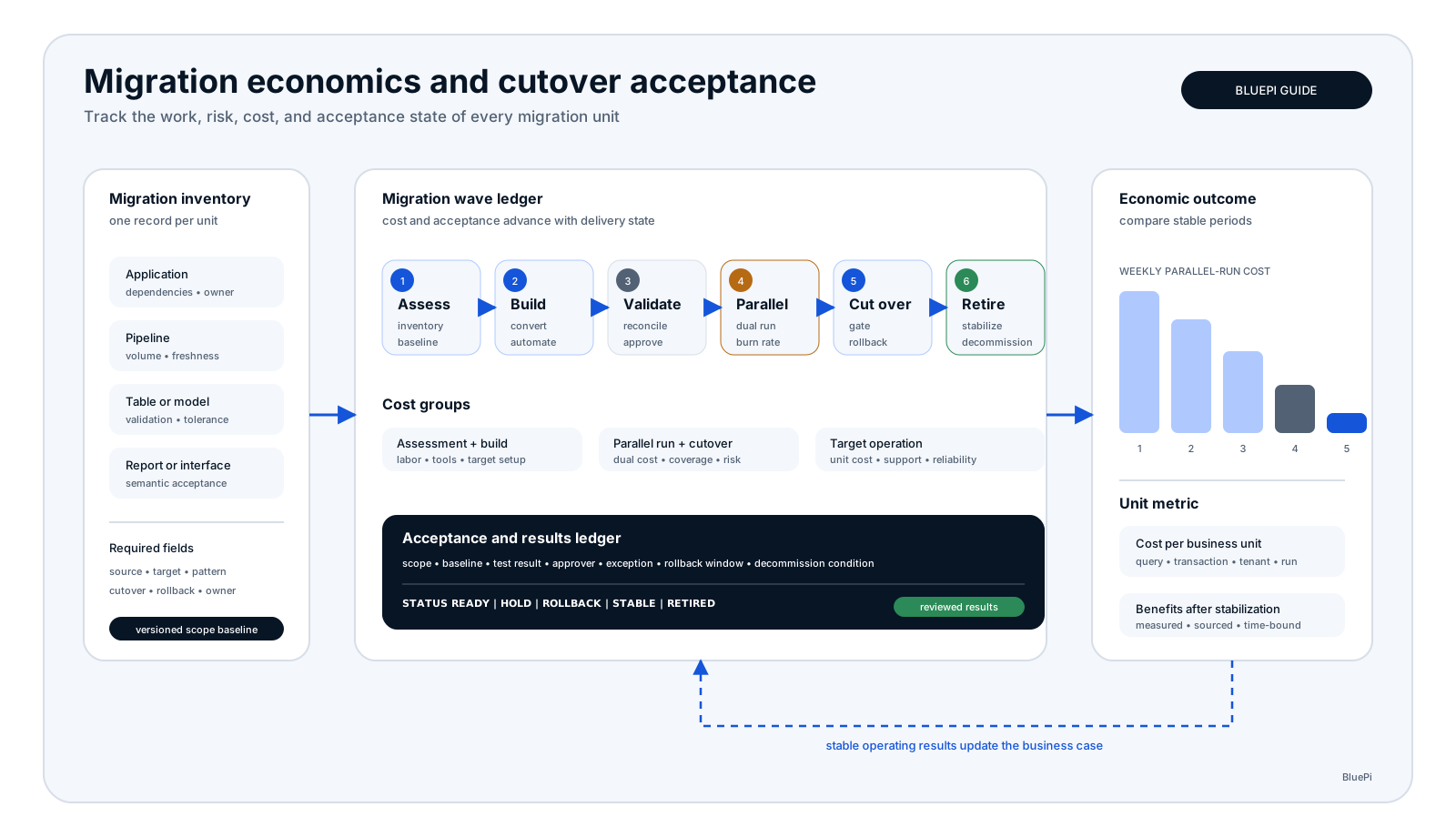
Inventory, baseline, treatment selection, platform controls, migration waves, reconciliation, cutover, rollback, and transfer form one delivery path.
03
BluePi began with cloud engineering and substantial AWS delivery. That experience now supports Google Cloud, data-platform, and AI delivery programs. That record spans AWS, Google Cloud, data platforms, and AI delivery, so treatment choices come from having run several generations of cloud systems.
Applications and data platforms, moved in measured stages: assessment, staged migration, reconciliation of results, security and cost controls, and rollback plans at each step.
Each stage carries reconciliation tests that compare old and new outputs, defined rollback points, and cost tracking, so the program can stop, hold, or reverse at a known boundary.
We will look at who owns the decision, the current baseline, the data involved, what the system must include, and the route to go-live.
Plan the migration path